Thursday, November 6, 2014

Ch-Ch-Ch-Changes

This Week in Pole brings changes, station opening, the official arrival of the summer season, new people... none of which have to be dealt with for long (fortunately) as it also means us winter-overs will soon (or already are) leaving the ice.

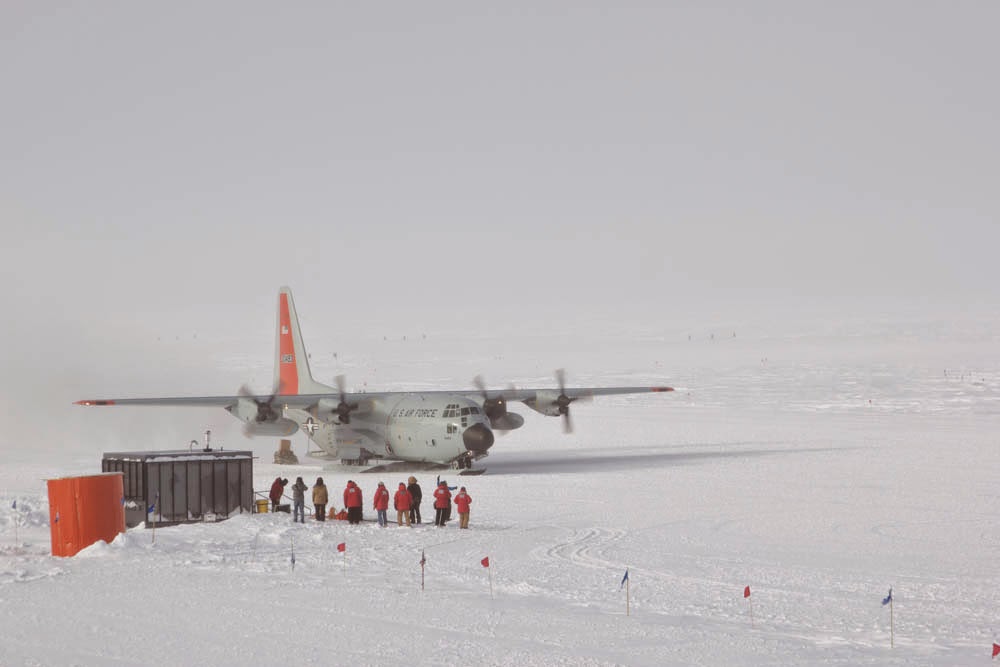
The first Herc of the summer finally reaches the Pole

New people and cargo are all brought to the South Pole from McMurdo via LC-130 (Hercules) planes operated by the Air National Guard. This year they set out from their base in New York with five planes, and subsequently left a trail of broken planes on their route to Christchurch/McMurdo. A week ago there wasn't even a functioning Herc on the continent. Now there are two. Because of a mix of these mechanical failures and bad weather, we received our first plane on 11/6, as opposed to 11/1. This backs up all the replacements and turnover for the summer season, and means many people may be getting out of there later than planned. 


New people on station means everything is changing rapidly as the summer season has officially started. But it's interesting to see just how the station itself has changed over the course of the winter. For one, large drifts develop over the course of the winter which must be plowed away during the summer.

"MAPO mountain"


A two-story drift develops around MAPO, a building in the dark sector that houses the machine shop and SPUD/Keck telescope. The drift is actually almost two stories tall, the windows you see there are the second story of the MAPO building, and the doors on the lower level are obscured by central smaller drift.

Drift upwind from the station


You can also see a drift develop upwind from the main station. The station is supposed to prevent drifts from forming under the station, and as you can see the area under the station is relatively flat. Apparently in 2012 this drift had hardly formed at all, but because not enough personnel are sent down in summer to properly clear it, the drift has been getting worse each year after that.

It is also interesting how our interactions have changed over the winter. At the start of the winter everyone was very friendly to each other, mostly because you don't want to start off on a bad footing with someone you will spend the next 9 months with. Of course, over time us winter-overs learned what truly terrible human beings each other are. Conflicts inevitably develop, resulting in hate, which festers over the course of the winter until it blossoms into spite - the purest of human emotions. Still, open conflict is rare - no one wants to rock the boat too much while everyone still has months to go. However, the final week before people depart, everyone will shortly fly off the ice and soon enough practically be dead to each other, allowing a unique opportunity to completely tell someone off right before parting ways. It's a beautiful thing.

At the end of winter, successful winter-overs are all given the Antarctic Service Medal. Anyone who spends 15-30 days below 60 degrees South in support of the USAP receives one of these, but winter-overs receive an extra "wintered over" bar.

Shiny


Other snowdrifts:

  • I avoid the new folks by hiding in my room. Every new named learned is a personal defeat.
  • In addition to LC-130s, DC-17s are also used for flights in between Christchurch and McMurdo. The Hercs also service larger field camps and other stations nearby McMurdo. 
  • The first herc also brought everyone their first mail, and in a few flights some of our mail should finally get out. 
  • The crew that came in early on the Basler managed to fix the Rodwell, so we are now on full water usage!
  • No, no one at pole voted because our mail-in ballots wouldn't reach the states in time

Next Week in Pole: All the Hercs on continent cease to function

Saturday, November 1, 2014

Packing for Pole

This week in pole I'll be discussing how to pack for a winter at the South Pole. Hopefully this is useful for future winterovers that stumble across this. As I am now packing my things up to leave the pole, I'm able to better reflect on what was actually necessary and what was completely useless down here.

Of course, you really don't need to bring anything. You could show up at the pole for a winter with 7 pairs of underwear, a pair of sneakers, and $500 in cash and be able to survive off of everything on station. You might have trouble getting through TSA with just that on, but still, down here there's a library with books and dvds, a computer lab if you don't have a laptop, and a station store to buy toiletries and clothes (which most people buy and wear around all the time anyway).

Anyway, like a good capitalist I wanted to bring my own stuff. I modeled the organization of my list off of one I found from Jeffrey Donenfeld's blog. Here's what I brought and some notes on if I thought it was necessary:


Mostly I found that I didn't bring too much in excess. Some notes of reflection:

  • Contacts! USAP said that contacts are bad here because of the dryness, but in my experience glasses were worse outside because of the fogging. It made aurora viewing much more unpleasant trying to wipe my glasses every minute. I'd definitely also bring a face mask to avoid glasses/goggle fogging. Something like the ones available from Cold Avenger.
  • I brought too many t-shirts and long-sleeve tops. Since I ended up purchasing some clothes at the station store, the extra clothes I brought were even more unnecessary. Plus it is so dry here that you don't sweat as much and can wear the same t-shirt 7 days in a row no problem (this might only be because I have absolutely no sense of smell). 
  • Even though the station store has toiletries, you might as well bring all the ones you will use. After all, this year our store ran out of floss a couple months into winter. 
  • I would have shaved more often if I had brought an electric razor
  • I covered what camera(s) to bring here
  • Rechargeable batteries and chargers were available on station (or at least a SPT). 
  • Some things, like fleece tops, glove liners, hats, and socks are provided in the ECW gear, however if you have favorites that are more comfortable consider bringing them. 
  • It could be nice to bring down some food you know isn't available here, and open it mid-winter. I didn't do this but SPT had a box arranged for us that we opened mid-winter. 
  • Could have used a French Horn down here, and Rock Band video game with drum set. 
  • Hardly anybody played Smallworld with me (jerks), might have had better luck with Twilight Imperium. My plan to descend the station into a modern Lord of the Flies with a game of Diplomacy (already on station) failed, although there is a pig's head on a stick down here, but pandemonium spread anyways several months later during the Great Water Crisis

If you are fortunate enough to know you will be going to Pole several months in advance, you can plan ahead and ship everything to yourself. Your address at Pole with be an APO, and everything will be shipped to you via Guard Mail. The price to ship things to/from pole is therefore just like using the US postal service in the states (so very cheap considering where you're shipping to/from). I didn't know I was coming down here early enough to use this, but I did ship several boxes home.

I should also note that down here you can get Prodeals on several sites. So if there is equipment you with to have only for travel afterwards, consider purchasing after you are down here and get a USAP email address. Just note it is hard to get it down here, you will have to find a way to get it to Christchurch for when you leave the ice. I got prodeals for promotive, Osprey, smartwool, and several other companies. 


Other Toiletries:
  • The Basler didn't actually take our mail out, because they needed a cargo number from up North that the cargo archons in denver would not provide. Typical government operation.
  • The Basler did take a polie away. One of our VMF guys had been on continent since Winfly 2013 (so here 14 months or so) and we very eager to leave. So he did. 
  • The Basler also returned with people from McMurdo who brought a new hot-water drill to help fix the Rodwell. They seem to actually be making some progress. 
  • We didn't do anything special for Halloween because everyone hates each other too much, but someone did put out year-old candy corn in the galley, which disappeared surprisingly fast -- I guess we are all hungry for a taste other than the usual galley fare. 
  • We did have our last concert, a "punk rock" show, because we were too lazy to move the equipment from the band room and crammed all 7 people who showed up into the small room. 
  • We were supposed to have our first C-130 flight in yesterday (November 1st), but it was delayed due to lack of plane and weather. We are expecting two flights on Monday, November 3rd. That could be 40-60 new people. Dreadful


Next Week in Pole: Definitely not murdering anyone!

Sunday, October 26, 2014

Aerial View

NASA's IceBridge mission recently flew over the South Pole and took this cool aerial shot.

I'm reposting it here with with descriptions:


In the upper-left you can see the "dark sector", which is home to the South Pole Telescope, Ice Cube Laboratory, and MAPO/SPUD (which is another telescope and a machine shop). South Pole Station is to the center, and you can see the three berthing units and gym extending from the station. To the upper-right of the station is the NOAA building, situated in the "clean air sector" (wind primarily comes from this direction). Below the station is "the berms" which is the storage/junkyard/graveyard of the South Pole. Below that is the RF sector, housing the satellite dishes that provide internet and transmit our science data. The "end of the world" is an emergency cache of fuel. 

I think a lot of people imagine a single station with a couple outbuildings surrounded by pristine snow, but the bird's eye view shows a different story. Things rarely leave this place once they are here, and therefore a large collection of junk has accumulated from old projects and past construction projects. 

The shot was taken just a day or two ago, so you can still see the Basler planes in the photo.

Thursday, October 23, 2014

Winding Down

Each day now we get closer to station opening, November 1st. This is the nominal date when we will see our first LC-130 flight (weather permitting). Inbound LC-130s have to wait until the temperatures are reliably above -50 F because that is the lowest temperature their landing gear hydraulics are rated for.

Even though the station has not yet opened, we have already seen a couple Twin Otters and Baslers fly through. Seeing the first new faces in 8 months, I did my best to completely avoid them. Although, one of the Basler crews was nice enough to bring in fresh fruit ("freshies"), and I enjoyed my first apple in months. The Basler's are actually still here, unable to escape the pole due to the poor weather we've been having the past week.

A Basler aircraft is stuck at the south pole in blowing snow. 

When the Basler's finally do make it out, they might even take some mail for us, which normally takes a long time to make it out on the LC-130s.

The Twin Otters and Baslers are operated by Kenn Borek Air, and fly down from Canada to McMurdo, where they service field camps. So unlike the LC-130s flying to Pole from Christchurch, they fly from Canada through the Americas, cross from Chile to Rothera Station, and then fly to Pole. I think sometimes they stop along the way, landing in the middle of nowhere to switch from tires to skies.

Although the winter is winding down, the work load on station has been increasing. On top of the ongoing Rodwell repairs, preparing for opening means that everyone is busy cleaning and organizing the station for the 40 people that will come in on the first flight. People who operate the loaders have been busy grooming the runway for incoming flights.


Other outgoing mail:
  • Everyone has also been busy packing up their rooms, and planning travel
  • I'm one of the unlucky ones who has to move rooms for the new people coming in, so I have to move rooms 10 days before I fly out anyway - this is a process winterovers generally consider extremely unfair
  • The weather the past week has been extremely poor, meaning the Kenn Borek Air crews have been stuck on station for days. I've been doing my best to hide. 
  • But wait! If there was a window of good weather, why wasn't the runway groomed? Why didn't the groomers get the previous day off so that they could prepare the runway overnight when the weather improved? Isn't getting the Baslers off base top priority since one of them is supposed to immediately return from McMurdo with a group of technicians that are supposed to fix the Rodwell? Why is the only person on station with experience as a fuelie no longer working in the fuel pit? These are good questions... please consult the Logic Column

Next Week in Pole: Trying to take over the world

Monday, October 13, 2014

The Great Water Crisis of 2014

The past few weeks have brought a flurry of activity to the station as we suffered a failure of our primary water system. As I've previously mentioned, we get our water from a pump that goes into a rodwell. Basically we shoot enough hot water down into a hole in the ice to maintain a pool of liquid water, which we pump back up to use. However, a few weeks ago this pump died. Because of this, we switched to a Snow Melter for our water supply. This means someone has out with a loader/tractor and retrieve snow to dump in the snow melter. While all of this was getting running, we were on conservative water ratios, so no showers or laundry. Now we are limited to one laundry or 2-minute shower a week (as opposed to the normal two showers and one laundry load).

I don't want to spend too much of the post assigning blame, but the general consensus is that the various temperatures on the control computer have been maladjusted by He Who Shall Not Be Named the entire season, to the dismay of all the utilities technicians on station. The temperature controls may have been maladjusted to the point where the water pump in the rodwell finally failed. Not only has this caused tons of extra work for people on station, but it also is likely costing the antarctic program hundreds of thousands in dollars. There were also repairs to the rodwell system done over last summer's season that weren't optimal, which also contributed to the failure.

Overall, I'd say one of the most surprising things I've found working at the South Pole is failures such as these. Some of the processes, e.g. hiring, psych evaluation procedures, internet controls etc. are really illogical. We have a procedure for dealing with instances like this, the logic column:


When you hear about something illogical done in the antarctic program, you bang your head on the logic column.

That being said, most of the people working here on station are great, and most of the people in Denver are too.


Other Logical Inconsistencies:

  • [redacted]
  • The world experts in ice drilling were required to fix the rodwell last Summer. They offered to come back to help fix our current rodwell problems but USAP has declined in favor of trying the same techniques that didn't work last summer.

Next Week in Pole: Ebola!

Wednesday, September 24, 2014

Good Morning Sunshine

September 23rd marked the spring equinox here in the southern hemisphere, and with it came the rising of the sun. The week and a half prior to the sun marked a steady brightening of the atmosphere. Known in the photography world as the "magic hour", for weeks before and after sunrise we have a happy medium of sunlight, bright enough not to stumble around on the sastrugi, but not yet bright enough to warrant shades. The dark sky eventually shrinks to form a mere shadow of the earth. 


The photo above shows a panorama of the earth's shadow. The sun is behind camera, below the horizon. The Earth's shadow is visible anywhere, but especially so at the South Pole due to the flat ice plain that extends in every direction and the long duration of the sunrise/sunset. The photo was taken 8-10 days before sunrise. The curved earth's surface projects onto the atmosphere, the dark blue shade is lined with purples that brighten as the sun nears the horizon and the shadow shrinks.

Before the sun physically crosses the horizon, you can start to see the refracted image of the sun, depending on the atmospheric conditions.


The above shot shows the refracted image of the sun, you can see the wavy nature of the image created by the layers in the earth's atmosphere. At these times, if you are lucky, you can see the "green flash".


The Green Flash occurs when a layer of the refracted image separates, isolating some greens and blues above the main image of the sun. The picture above, taken through a telescope, shows the separated Green Flash layer. 


Sunrise also brings some other interesting atmospheric effects, such as the Sun Pillar shown above, a result of ice crystals in the atmosphere and some other science taking place while the sun is obscured behind the clouds. 


Unlike sunset, which was mostly obscured by clouds and storms after the sun crossed the horizon, the days leading up to sunrise brought some nice cloud formations like the one shown above. 

Per South Pole tradition, we also had a sunrise dinner. Unlike the sunset dinner and mid-winter dinner, sunrise was more informal - more of a cocktail party. The reason for this is that by this point in winter everyone hates each other too much to sit at the same table for two hours. Most importantly, sunrise dinner marked the reveal of the 2015 South Pole Marker. Each year, the winter machines builds the new South Pole Marker. At new years, they recalculate where the actual South Pole is and put a new marker at the correct position. 


The above shot shows the station machinist with the new marker he made. We voted on the design and his was the winner. The new marker will be installed on New Years 2015. Unfortunately, there is an inexplicable NSF policy not to reveal the new marker before hand, which is why it is pixilated. 


Shortly after sunrise the telescope broke again, here's a photo of the repairs for no particular reason. 


Other rays of sunshine:
  • No, just because the sun is up doesn't mean it's warm all of the sudden. The temperatures won't regularly get above -50 F for another month, that's why there aren't planes yet.
  • You can also see a green flash by staring directly at the sun for thirty seconds and then looking in any direction

Next Week in Pole: Spitefulness Versus Time in South Pole Winterovers - A Case Study


Twilight Ascends

Several weeks ago (I'm quite behind here) brought astronomical twilight, followed by nautical twilight and civil twilight. During this period sunlight slowly erased the stars from the nighttime sky, illuminating an ever growing region of the horizon with pink and purple light. 


The end of aurora season officially erases any reason for existing here, but it does illuminate the cloud structure, which is nice.


As people start to see the sun, they become aware that eventually, they will leave this place. There's a reason september is known as "Shopping September". All the paychecks we have accumulated are suddenly spent on items we'll receive upon returning hope, and weeks later forget about. People also spend a significant amount of time discussing and planning for the upcoming travel when they get off the Ice. 

Other notes:
  • No more aurora, ever...
Next Week in Pole: Staring at the Sun.